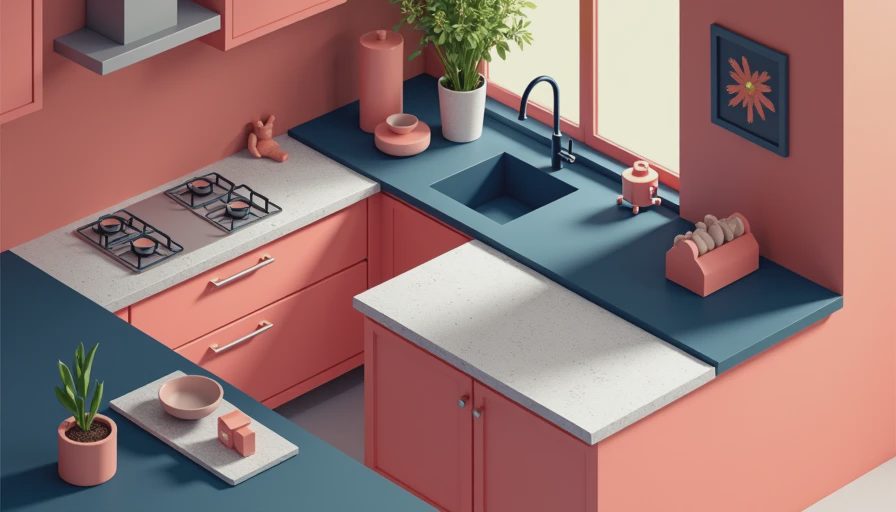
Let me guess — you’re standing in a showroom staring at glossy slabs, and your only thought is, “Which one won’t make me want to cry when my kid spills grape juice on it for the third time this week?” I’ve been there. After two kitchen remodels in my suburban Indianapolis home (the first one was a mistake factory), I learned that the **best durable countertops for real family kitchens with heavy use** aren’t the ones that look fancy in a magazine. They’re the ones that still look good after a week of breakfast, homework, and dinner chaos.
When you’re feeding a family, you need countertops that laugh off hot pans, spilled tomato sauce, and the occasional dropped jar. You don’t need a museum piece — you need a work surface that keeps up with actual life. So let’s cut through the sales pitch and talk about what actually holds up.
Why Family Kitchens Need More Than Just Pretty Countertops
Raising kids means your kitchen counter sees more abuse than a freeway on-ramp. Acidic foods, endless crumbs, hot cookware straight off the stove, and craft projects gone rogue. The wrong material chips, stains, or etches faster than you can say “redo the backsplash.” And here’s the thing — a countertop that looks pristine on day one but demands constant sealing or babying isn’t a good investment for a busy home. You want something that can take a beating without a maintenance routine that eats your weekends.
The **best durable countertops for real family kitchens with heavy use** share a few traits: they resist heat, scratches, and stains without extra sealing. They’re easy to clean with regular soap and water. And if they do get damaged, the fix isn’t a full replacement. Let’s break down the top contenders.
Quartz: The Low-Maintenance Workhorse for Busy Families
If I had to pick one countertop for a family with young kids, quartz is my go-to. It’s engineered stone — crushed quartz held together with resin — and it’s non-porous, so you never need to seal it. Spilled coffee? Wipe it up. Red wine? Gone. Even lemon juice won’t leave a mark. Quartz handles heavy use like a champ. Brands like Cambria, Silestone, and Caesarstone are everywhere, and you’ll pay anywhere from $50 to $120 per square foot installed.
The catch? Quartz can’t take direct heat well — setting a blazing hot pan directly on the surface might cause a burn mark. Always use a trivet. Also, while it’s tough against scratches, it’s not indestructible. But for most families, it’s the best balance of durability and zero-fuss cleaning. That’s why quartz tops many lists of the **best durable countertops for real family kitchens with heavy use**.
Granite: Natural Beauty That Can Take a Beating
Granite is the old reliable — a natural stone that’s been in kitchens for decades. It’s hard, heat-resistant (you can put a hot pot right on it), and stands up to scratches better than most materials. With proper sealing once a year (some sealers need more frequent application), granite shrugs off stains and daily wear. Expect to spend $40 to $100 per square foot installed, depending on the slab.
Downsides: granite is porous, so skipping the seal means stains soak in. And it’s heavy — your cabinets need to support it. Also, that “natural beauty” can vary wildly. Some slabs have veins or pits that catch crumbs, which drives me nuts. But if you pick a dense, well-sealed slab, granite will outlast your kids’ teenage years. It’s a solid contender when you’re weighing **best durable countertops for real family kitchens with heavy use**.
Solid Surface (Corian and Similar): Seamless and Repairable
Solid surface materials like Corian are often overlooked, but they’re surprisingly family-friendly. They’re non-porous, seamless (no grout lines for crumbs to hide in), and — best feature — minor scratches and burns can be sanded out. You can’t do that with granite or quartz. Prices range from $40 to $80 per square foot installed.
The trade-off: solid surface isn’t as heat-resistant as granite or quartz; a hot pan will leave a mark. And it can scratch more easily. But because it’s repairable, a few scratches aren’t the end of the world. For a busy family that might live in the kitchen for 10–15 years, repairability makes solid surface a practical choice.
Porcelain Slabs: The Up-and-Coming Heavyweight
Porcelain countertops (made from fired clay, often used in large-format tiles) are gaining traction because they’re incredibly hard, non-porous, and heat-proof. You can put a 500°F pan directly on porcelain without flinching. It’s also UV-resistant, so it won’t fade in sunny kitchens. Cost? High — $60 to $150 per square foot installed, plus specialized fabrication.
Downsides: porcelain is brittle during installation (chips easily before it’s set), so you need an experienced crew. And once it’s in, it’s tough but not scratch-proof — a sharp knife can leave a mark. Still, for the ultimate “set it and forget it” surface, porcelain is worth a look.
A Note on Natural Stone (Marble, Soapstone) — Not for Everyone
Marble is beautiful, but it’s a nightmare in a family kitchen — it etches from any acid (lemon, tomato, even orange juice) and stains easily. Soapstone is softer and doesn’t stain, but it scratches and dents. Both require regular maintenance. Unless you’re okay with a “patina” of wear, skip these for heavy-use kitchens. They’re not among the **best durable countertops for real family kitchens with heavy use** unless you’re very relaxed about perfection.
Making the Choice That Fits Your Home
So which one wins? If I had to start fresh today, I’d go with quartz — it hits the sweet spot of durability, low maintenance, and decent price. But if you cook a lot with hot pans and don’t mind annual sealing, granite is a close second. For the handyman types, solid surface offers repairability that’s hard to beat. Porcelain is the premium option if budget allows.
Before you sign that countertop contract, think like a dad who’s already cleaned up one too many spills. Your kitchen needs to live, not just look good for Instagram. Pick the material that lets you focus on the family, not the countertop care. Good luck — you’ve got this.

No letters yet — be the first to write.